
The golf shop resource library
Golf shop open-to-buy: plan what you can still commit
Open-to-buy is the merchandise purchasing capacity that remains for a defined period after existing stock and commitments are considered. It helps a golf shop connect its sales outlook and desired ending stock with the next buying decision.
The starting pointDefine the period and valuation basis, calculate planned receipts, then subtract the orders already committed for that period.
MERCHED builds this plan from your shop’s own sales history. See the merchandise planning software
01
Start with a period and a consistent valuation basis
Choose a month or another clearly defined selling period. A seasonal budget gives the overall direction, while a period-by-period review exposes deliveries that arrive too early, too late, or all at once. Use the same boundaries for sales, starting stock, ending stock, and expected receipts.
Keep retail value and merchandise cost separate. A wholesale purchasing budget cannot be subtracted directly from inventory valued at selling price. The two examples below use independently stated inputs on their own valuation basis; one is not a conversion of the other.
02
Calculate planned receipts, then remaining open-to-buy
On a retail basis, planned receipts equal planned sales plus planned markdowns plus desired ending inventory, minus beginning inventory. Then subtract merchandise already on order for delivery during that period to find the remaining uncommitted open-to-buy.
Markdowns account for a reduction in the retail value of stock that is not a sale at the original ticket price. Include them once and use an internally consistent inventory valuation. Treat this as a general retail planning calculation, rather than a description of MERCHED’s recommendation algorithm.
03
Check commitments using cost values
For a simple cost-basis plan, start with the expected cost of goods sold, add the desired ending inventory at cost, and subtract beginning inventory at cost. That gives planned receipts at cost. Subtract outstanding orders due in the same period, also at cost, to find the remaining uncommitted amount.
Cost of goods sold is the inventory cost of the merchandise expected to sell, not the sales revenue. A retail markdown changes the selling price; do not add retail markdown dollars to this cost calculation. Account separately for write-downs, shrinkage, returns, or transfers when they apply.
- Expected cost of goods sold: $15,000.
- Desired ending inventory at cost: $20,000; beginning inventory at cost: $22,000.
- Planned receipts at cost: $15,000 + $20,000 − $22,000 = $13,000.
- Outstanding orders due in the period at cost: $5,000; remaining uncommitted capacity: $8,000.
04
Give each category and brand a share of the same budget
Set category allowances inside the approved total, then assign brand commitments within each category. A vendor minimum is a constraint to evaluate, not additional money. If meeting it would exceed the category allowance, revise another commitment or seek approval before increasing the buy.
Keep a deliberate amount uncommitted if the shop needs flexibility for later evidence or deliveries. There is no universal reserve percentage: choose it around your selling window, ability to reorder, and existing obligations.
- Label the total, category allowances, and brand commitments with the same period and cost or retail basis.
- Include already-confirmed orders once, with their expected receipt dates.
- State whether freight, logo charges, and other costs are included or separately reserved.
- Reconcile committed amounts plus the uncommitted allowance to the approved total.
05
Make the number useful for a golf shop
Review the remaining amount by category and delivery window. Capacity in headwear does not necessarily justify another rainwear order. A member-guest delivery also needs to be separated from regular shop stock if the event purchase has its own funding and demand.
Keep an up-to-date commitment record outside the calculation’s assumptions: what has been ordered, what is due, and what has changed. As receipts arrive, avoid counting the same merchandise as both stock on hand and an outstanding order. Revisit the forecast if weather, rounds, or an event cancellation changes the outlook.
Carry the available amount into your next vendor buying brief.
06
Use a negative balance as a review signal
A negative result means the stock and commitments in the calculation exceed the planned need. First check the dates, valuation basis, duplicate commitments, and forecast. If the inputs are sound, review future orders with vendors before making more commitments; do not assume that cancellations or returns are available.
A positive result is capacity, not an instruction to spend every dollar. Check category demand, margin expectations, presentation needs, and the shop’s actual cash budget. Keep the reason for any decision to spend, defer, or reduce a buy visible to the team.
Ground the sales assumption in comparable historical performance.
From process to practice
Where MERCHED fits
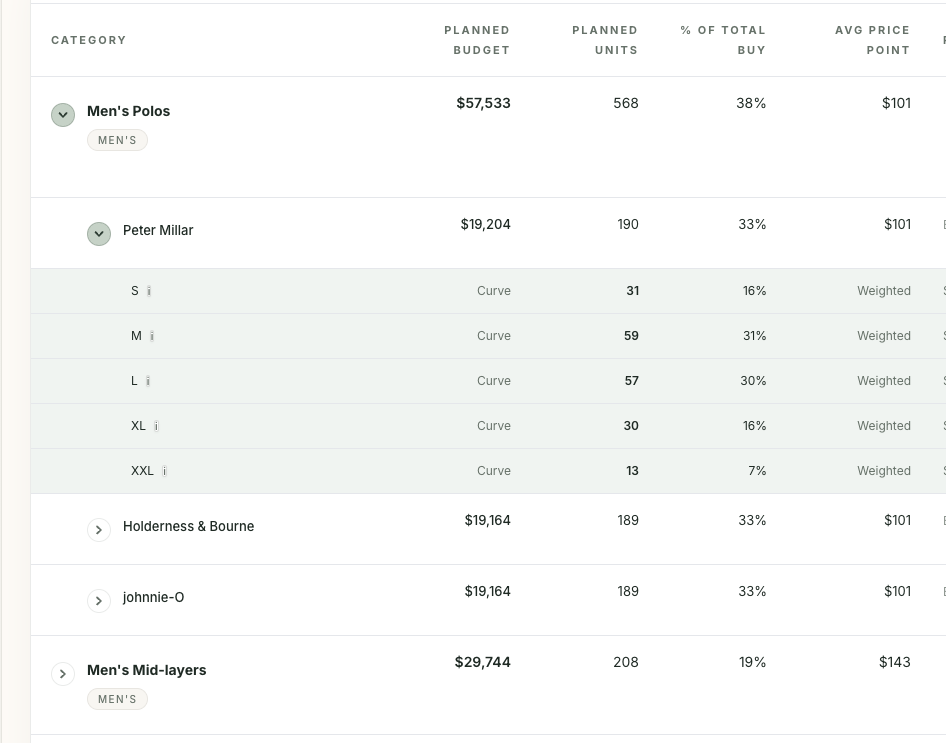
MERCHED supports seasonal merchandise planning with uploaded performance history, shop inputs, budget guardrails, and category and brand recommendations. Uploaded current inventory can provide planning context; it is a snapshot, not a live stock feed. Use the recommendation as a data-backed starting point and reconcile your current commitments before approving the final plan. MERCHED does not provide live inventory management, live POS integration, or automated vendor ordering.
Explore our merchandise planning software, see How It Works, or read Built for Golf for the shop-specific inputs behind the recommendation.
Questions from the shop
Frequently asked questions
Is open-to-buy the same as my seasonal budget?
No. A budget is an overall spending guardrail. Remaining open-to-buy changes with the period’s sales outlook, stock targets, and existing commitments. A shop can be within its season budget while already overcommitted for a particular month or category.
Do I subtract orders that have already arrived?
Received merchandise belongs in the appropriate inventory or receipts record, not in outstanding orders as well. When updating an in-period plan, roll the inventory position and remaining-period forecast forward together so you do not double-count receipts.
Should golf shops use cost or retail open-to-buy?
Either basis can support planning if every input and formula is consistent with that basis. This guide gives separate retail and cost examples. Cost calculations use the expected cost of goods sold, not sales revenue; retail markdown amounts should not be added to a cost calculation. Check the result against the approved purchasing budget.
Bring more structure to your next buy.
Build on your shop’s history with every season you plan. Give MERCHED more context, review the recommendation, and make the final plan your own.
Get Started