
The golf shop resource library
How to build a golf apparel size curve
A size curve is the share of an apparel buy assigned to each size. It helps turn a unit target into a useful size run, but recorded sales only show what customers could buy from the stock available. Start with comparable history, then review the gaps before placing an order.
The starting pointUse your shop’s unit sales to build a starting mix, check availability and fit, and make every size quantity add back to the approved buy. There is no universal golf-shop size ratio.
MERCHED builds this plan from your shop’s own sales history. See the merchandise planning software
01
Group products that belong in the same size decision
Choose a comparable selling period and a specific apparel group. Men’s polos, women’s tops, youth apparel, numeric-waist bottoms, and footwear need separate consideration. Check brand, fit, and customer differences before pooling their history. Separate tournament gifts and special orders from ordinary shop sales.
Keep the original POS size labels. Confirm equivalent labels such as Medium and M before grouping them; do not convert a numeric size into an alpha size without a verified product-specific mapping. A blank apparel size is unknown, not evidence that the item is One Size.
A brand’s size chart explains measurements and fit, not how many units your members will buy. Peter Millar’s fit guidance, for example, distinguishes Classic and Tailored fits. Check the actual collection and product before carrying a size mix across fits.
Fit reference: Peter Millar’s Classic and Tailored fit guidance
03
Check stockouts and thin evidence before trusting the mix
Sales stop when a size is unavailable, even if customers still want it. Check receipt dates, stockout periods, and staff observations alongside the totals. A size that arrived late or sold out early did not have the same selling opportunity as one available throughout the season.
A stockout is a reason to question the recorded share, not enough information to calculate the exact sales you missed. Do not inflate a size by a fixed percentage without a reason. Record any buyer adjustment separately from the original sales evidence.
When evidence is thin, consider a broader but still comparable group or a clearly labeled starting assumption. Record the number of units, period, and missing-size coverage behind the choice. There is no single sample threshold that makes every category reliable; a handful of sales should not be presented as a precise demand forecast.
04
Turn the mix into a whole-unit size run
First set the new purchase quantity after considering usable stock and outstanding orders. Here the buyer has approved 24 new polos for one style-color option. Multiplying 24 by the observed shares gives 2.4 S, 6.6 M, 7.8 L, 5.4 XL, and 1.8 XXL. Those fractions must become a total of exactly 24 units.
One transparent rounding method is to round every quantity down, then give the remaining units to the largest fractional remainders. The rounded-down quantities total 21. Give the three remaining units to L, XXL, and M, producing 2, 7, 8, 5, and 2. If remainders tie for a final unit, use a consistent tie rule and record any buyer override.
| Size | Starting run | Buyer scenario |
|---|---|---|
| S | 2 | 2 |
| M | 7 | 8 |
| L | 8 | 7 |
| XL | 5 | 5 |
| XXL | 2 | 2 |
| Total | 24 | 24 |
05
Check fit, vendor packs, and the final commitment
A category curve does not guarantee a workable size run for every style and color. Inspect each option. Dividing a small buy among too many colors can leave little useful depth even when the category total looks reasonable.
Confirm the vendor’s available sizes, pack quantities, minimums, and delivery dates. If packs force a larger buy, recalculate units and cost and resolve the difference before ordering. Do not quietly raise the approved total or drop a needed size just to make the arithmetic fit.
- Keep the original sales period, usable-size coverage, and availability notes with the plan.
- Distinguish observed size shares, assumptions, and buyer adjustments.
- Reconcile size units to each style-color total and those totals to the category buy.
- Check existing stock and orders once, then confirm costs, packs, logo charges, freight, and budget.
- Confirm vendor availability and approve the final quantities before placing orders.
From process to practice
Where MERCHED fits
MERCHED includes size quantities within its recommendation workflow. Its sizing logic can use sales history, order history, or an assumed category curve, depending on the available evidence. An order describes what was bought; it is not proof of what sold. Review the size source and assumptions alongside the proposed units. The teaching calculation above explains the allocation decision rather than reproducing the complete recommendation engine. Vendor availability and the final order remain the buyer’s responsibility.
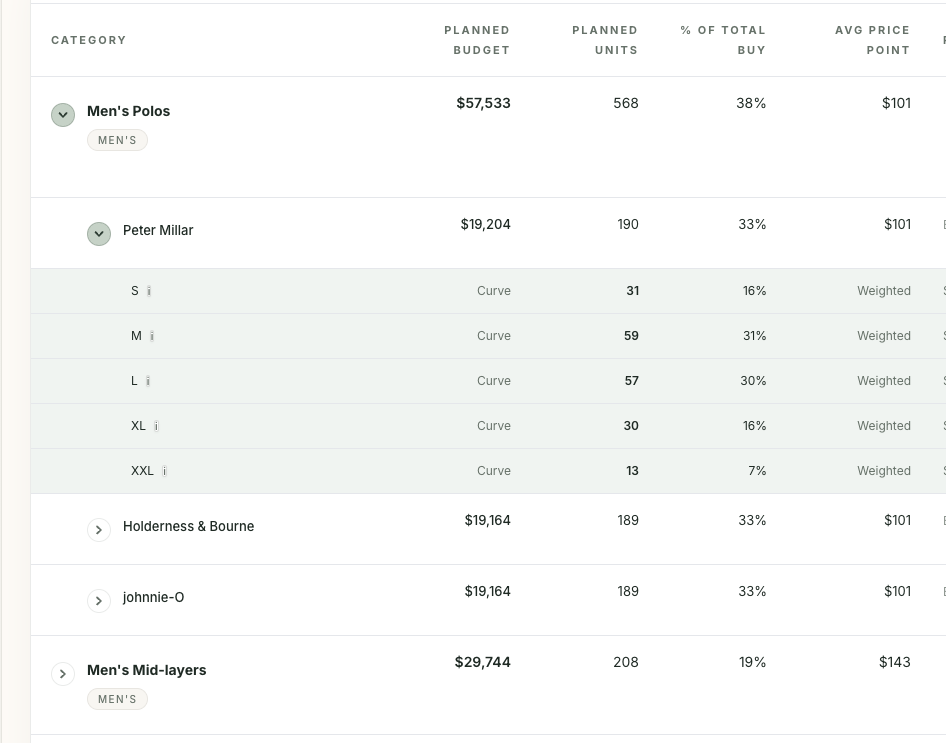
Explore our merchandise planning software, see How It Works, or read Built for Golf for the shop-specific inputs behind the recommendation.
Questions from the shop
Frequently asked questions
What is the best size ratio for a golf shop?
There is no universal ratio. Use comparable unit sales for the relevant category, customer, brand, and fit, then check stock availability and missing-size coverage. Keep any fallback or buyer adjustment labeled as an assumption.
Can I build a size curve if some sales have no size?
You can calculate a starting curve from the usable records, but report how much of the total they cover. Unknown sizes should not be treated as One Size or distributed as if they were observed. If no reliable size history remains, use an explicitly reviewed assumption rather than claiming a measured curve.
What if the rounded size quantities do not equal my buy?
Reconcile the whole-unit allocation to the approved total before ordering. Rounding down and assigning the remaining units to the largest fractional remainders is one method. Then review vendor packs, minimums, and size coverage; any change to the total needs a new budget check.
Bring more structure to your next buy.
Build on your shop’s history with every season you plan. Give MERCHED more context, review the recommendation, and make the final plan your own.
Get Started